.jpg)


An unexpected paradise - Cuatir Nature Reserve

In the evening, as the sun descends towards the horizon, the intense heat of the day begins to subside and the spectacle of sunset becomes a transcendent experience. From the terrace of the main building at Cuatir Natural Reserve, overlooking the savannah that stretches to the horizon, visitors feel emotions that only "Africa's last truly wild area" can offer.
Original text by SUSANA GONÇALVES and published in the April / May 2026 edition of AUSTRAL (inflight magazine of TAAG Linhas Aéreas de Angola) (c) 2026 TAAG.
The murmur of vegetation dancing in rhythm with the wind, the sound of an orchestra of birds and insects, and the sensation of serenity that only the African bush provides help to create the perfect setting for the end of the day. The magic increases when one of the many animals inhabiting the reserve decides to cross the plain between the camp base and the River Cuatir, on whose banks sits Angola's only private reserve.
The Cuatir Conservation Project was born in 2012, the fruit of the dream of Stefan Van Wyk, a
conservationist born in Namibia, now also an Angolan citizen and a pioneer of ecotourism in
southeastern Angola. Raised on a cattle and hunting farm and a licensed pilot, Stefan recalls
how he discovered this "paradise" whilst flying over it in a light aircraft to conduct a photographic survey of the Cuando Cubango territory for the new tourism master plan. He spotted an area with no trace of human activity, which he quickly identified as ideal for the sustainable reintroduction of wildlife along the lines of "Noah's Ark."
He returned by helicopter to be able to land and confirm the absence of human occupation, and shortly afterwards began the concession process. He immediately invested in a conservation model that involved neighbouring communities, convinced that "community-based tourism is the only lasting model."
In January 2026, this commitment was recognised by Corps Touristique (CT), an international
tourism association with more than 70 years of history, which honoured Cuatir Natural Reserve for its exceptional approach to sustainable tourism and for demonstrating how this can protect nature and create real opportunities for local communities. An award that the entrepreneur defined as "recognition of the people who, on the ground, every day, give life to this project."
AN OLD LOVE
Stefan's connection to Angola is longstanding: his father worked on farms in Lubango and Caraculo. His first trip to Namibe in 1990 marked the beginning of his passion for southern Angola. In 1995, he began tourism activities with a small airline company, focused on small groups and quality experiences. In 1997, he participated in building the Flamingo Lodge in Namibe, "Angola's first lodge". When he discovered Cuatir in 2012 and decided to establish a conservation reserve there, many were doubtful: "there aren't even any animals
there," they said. But Stefan knew the region's potential.
Reaching the reserve was an odyssey: with no roads, the first visits were made by helicopter.
"We chose the site for the base, cleared the way with machetes and transported materials in mokoros (canoes) along the River Cuatir. Later we imported a raft and, subsequently, built a
landing strip. They were intense years, but they were worth it," he says.
Gradually, the animals driven away by the civil war learnt to trust their new neighbours and to allow themselves to be glimpsed amongst the savannah vegetation. Antelope such as red hartebeest, impalas, and sable antelopes were joined by eyres and giraffes from Namibia that were successfully reintroduced.
In 2024, it was the turn of 26 elephants from Mount Etjo in Namibia, which traveled 600 km in
four challenging journeys, in an epic operation documented in the film "A Land for Giants" by Byron Pace. Reunited in Cuatir, whence their ancestors had departed decades ago, they quickly adapted to their new habitat. In the 20,000 hectares of African savannah at the reserve, despite everything kept almost untouched during the war, discrete felines also live, such as the cheetahs recently observed by some visitors.

DISTINCTIVE EXPERIENCES
Protecting wildlife is Cuatir's main objective, but not its only activity. A lodge with seven premium chalets and a bush camp welcome tourists interested in the region's beauty and fauna. Among the experiences available are animal tracking with San guides, wildlife observation tours across the savanna, or canoe excursions on the River Cuatir. These activities can be combined with others provided by Uncharted Experiences, a tourism company pioneering community-based tourism, founded by Stefan to show the world "the extraordinary country that Angola is" and which currently works on various community projects.
Road access to the reserve requires 4X4 vehicles and includes crossing the River Cubango on
a raft, thrills which, despite the hardship of the journey, provid unique memories. However, the lodge offers various transport alternatives to those interested in spending a few unforgettable days in this wild territory .
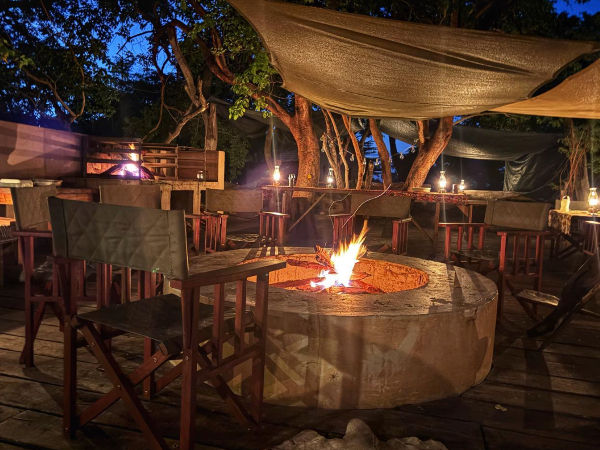
Protecting wildlife is Cuatir's main objective, but not its only activity.
A lodge with seven premium chalets and a bush camp welcome tourists interested in the region's beauty and fauna.
ENCOURAGING RESULTS
The progress of the Cuatir project's conservation efforts has been monitored and measured
since 2017 by a team of researchers from BIOPOLIS-CIBIO Association (University of Porto, Portugal), whose monitoring has recorded, so far, 32 mammal species, 155 bird species and 24 tree species. Filipe Rocha, one of the researchers studying large mammal communities in Angolan conservation areas – Bicuar and Iona National Parks and the Cuatir Conservation Area, explains to us that, in Angola, excessive hunting reduces species and populations and compromises ecological processes such as herbivory and predation, in addition to altering fire regimes, already exacerbated by limited conservation in protected areas.

For the researcher, projects that include the translocation of large mammals, such as those carried out at Cuatir, have clear benefits: "Beyond the economic impact associated with attracting tourism, these initiatives promote the recovery of ecosystem functioning". The monitoring carried out "shows that the reintroductions have contributed not only to an increase in predators, such as cheetah and leopard, but also to changes in herbivore populations, including the growth of the roan antelope and the regulation of common duiker. Previously the most dominant species, whose sightings have been reduced by half."
Stefan is now considering reintroducing rhinoceros to the reserve region; they have been
absent since 1975. "The issue is that the presence of rhinoceros requires very serious and competent rangers," he explains.
Poaching is a critical threat to endangered species, but Stefan's commitment to community-based tourism led him to involve the small local communities, the Nganguelas and the Camussequeles (San), in the project. He mentions, for example, "the extraordinary trackers from the San communities neighbouring the reserve, capable of tracking animals in a unique
way and who have provided unforgettable experiences to visitors.
And he concludes with undisguised enthusiasm: "These communities understand that tourism brings them more benefits than poaching, which has never been recorded at Cuatir."
AMBITIOUS FUTURE
The encouraging results achieved so far inspire Stefan to plan to expand the reserve to accommodate more large fauna. A process that is now with the Council of Ministers awaiting initial approval and which is being implemented in close collaboration with
Natural Selection, a safari operator focused on conservation and which is now working on
its first venture in Angola. Colin Bell, co-founder of the company and photo tourism pioneer in Southern Africa, revealed to the Tourism Update portal that a concession of 250,000 hectares has been requested as an extension to the reserve, which could make it Africa's largest private park, surpassing Tswalu (South Africa) and Erindi (Namibia).
The current 20,000 hectares of this conservation project at Cuatir could expand to around
250,000, strengthening Stefan Van Wyk's arguments: "We need more conservation areas and
better management," he says. "In other countries it is very common to hand over the management of these areas to specialised organisations, such as African Parks (which is already at Iona) and other NGOs that can raise substantial funds and apply them to these spaces, which benefit greatly from their know-how." A reality he aspires to see realized
in the Angola of which he speaks with enormous passion.
----------
Contact information :
Stefan Van Wyk
Mobile +244940888784 | Whatsapp: +264811288510


Comments